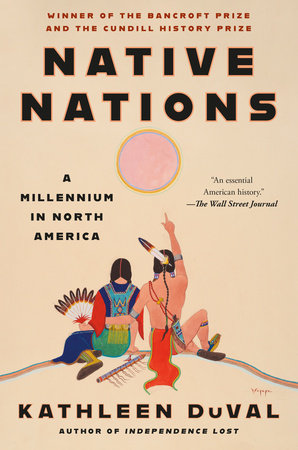
For a distinguished and appropriately documented book on the history of the United States, Fifteen thousand dollars ($15,000).

Native Nations: A Millennium in North America, by Kathleen DuVal (Random House)

A panoramic portrait of Native American nations and communities over a thousand years, a vivid and accessible account of their endurance, ingenuity and achievement in the face of conflict and dispossession.

Winning Work

Native Nations: A Millennium in North America

Native Nations by Kathleen DuVal

“A magisterial overview of a thousand years of Native American history” (The New York Review of Books), from the rise of ancient cities more than a thousand years ago to fights for sovereignty that continue today

WINNER OF THE BANCROFT PRIZE, THE CUNDILL HISTORY PRIZE, AND THE MARK LYNTON HISTORY PRIZE

Long before the colonization of North America, Indigenous Americans built diverse civilizations and adapted to a changing world in ways that reverberated globally. And, as award-winning historian Kathleen DuVal vividly recounts, when Europeans did arrive, no civilization came to a halt because of a few wandering explorers, even when the strangers came well armed.

A millennium ago, North American cities rivaled urban centers around the world in size. Then, following a period of climate change and instability, numerous smaller nations emerged, moving away from rather than toward urbanization. From this urban past, egalitarian government structures, diplomacy, and complex economies spread across North America. So, when Europeans showed up in the sixteenth century, they encountered societies they did not understand—those having developed differently from their own—and whose power they often underestimated.

For centuries afterward, Indigenous people maintained an upper hand and used Europeans in pursuit of their own interests. In Native Nations, we see how Mohawks closely controlled trade with the Dutch—and influenced global markets—and how Quapaws manipulated French colonists. Power dynamics shifted after the American Revolution, but Indigenous people continued to command much of the continent’s land and resources. Shawnee brothers Tecumseh and Tenskwatawa forged new alliances and encouraged a controversial new definition of Native identity to attempt to wall off U.S. ambitions. The Cherokees created institutions to assert their sovereignty on the global stage, and the Kiowas used their power in the west to regulate the passage of white settlers across their territory.

In this important addition to the growing tradition of North American history centered on Indigenous nations, Kathleen DuVal shows how the definitions of power and means of exerting it shifted over time, but the sovereignty and influence of Native peoples remained a constant—and will continue far into the future.

“An essential American history”—The Wall Street Journal

Biography

Kathleen DuVal is a professor of history at the University of North Carolina at Chapel Hill, where she teaches early American and American Indian history. Her previous work includes Independence Lost, which was a finalist for the George Washington Prize, and The Native Ground: Indians and Colonists in the Heart of the Continent. She is a coauthor of Give Me Liberty! and coeditor of Interpreting a Continent: Voices from Colonial America.
 

Finalists

Nominated as finalists in History in 2025:

Seth Rockman

A layered analysis of the manufacture and movement of tools and other everyday products between the North and South–from New England businesses to Southern planters and their enslaved workers–and how they created a shared economy.

The Jury

Jefferson Cowie(Chair)

James G. Stahlman Professor of History, Vanderbilt University

Daina Ramey Berry

Michael Douglas Dean of Humanities and Fine Arts, University of California, Santa Barbara

Julio Capó Jr.

Associate Professor of History, Florida International University

Julian Lim

Arthur Eisenberg and Susan Engel Associate Professor of History, Johns Hopkins University

Sarah Pearsall

Professor of History, Johns Hopkins University

Winners in History

Jacqueline Jones

A breathtakingly original reconstruction of free Black life in Boston that profoundly reshapes our understanding of the city’s abolitionist legacy and the challenging reality for its Black residents.

Jefferson Cowie

A resonant account of an Alabama county in the 19th and 20th centuries shaped by settler colonialism and slavery, a portrait that illustrates the evolution of white supremacy by drawing powerful connections between anti-government and racist ideologies.

Ada Ferrer

An original and compelling history, spanning five centuries, of the island that became an obsession for many presidents and policy makers, transforming how we think about the U.S. in Latin America, and Cuba in American society.

Marcia Chatelain

A nuanced account of the complicated role the fast-food industry plays in African-American communities, a portrait of race and capitalism that masterfully illustrates how the fight for civil rights has been intertwined with the fate of Black businesses.

2025 Prize Winners

Staff of The Wall Street Journal

For chronicling political and personal shifts of the richest person in the world, Elon Musk, including his turn to conservative politics, his use of legal and illegal drugs and his private conversations with Russian President Vladimir Putin.